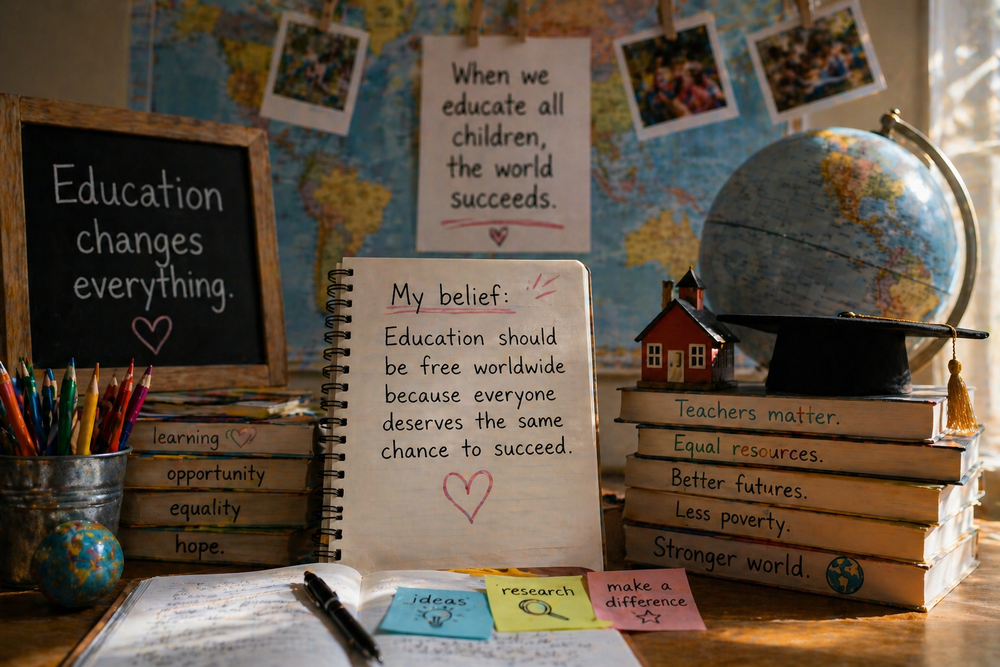
Education should be free worldwide because everyone should have access to the same resources, regardless of money, to create equal opportunities. Equal education would decrease poverty because better education provides people with the skills needed for more job opportunities with greater salary. In order for there to be equal education, teachers should be paid fair wages, and schools should have equal classroom supplies so that every student can succeed. Although people may argue that free education would cost too much money for the government, if people are equally educated, there would be an increase in higher paying jobs, which would bring more money to the government and reduce poverty. Education should be provided to all children worldwide, regardless of economic status, because when children are equally educated, the world will succeed.
Free education worldwide would decrease poverty because education leads to greater opportunities and higher paying jobs. Children everywhere would learn how to read and write, as well as other subjects like math, science, social studies, and technology. With these skills, students gain the knowledge needed to eventually get jobs with good earnings. They grow up to take care of their families, which will help break the cycle of poverty. The World Bank Group is an international organization and largest source of funding for education in developing countries. One way it works to reduce poverty is through building schools and training teachers. Per the World Bank Group, "In low- and middle-income countries, the share of children living in Learning Poverty (that is, the proportion of 10-year-old children that are unable to read and understand a short age-appropriate text) increased from 57% before the pandemic to an estimated 70% in 2022." (The World Bank, 2025, paragraph 5). The World Bank also agrees that education is the key for good jobs and to end poverty. According to the World Bank Group, "For individuals, education promotes employment, earnings, health, and poverty reduction. Globally, there is about a 10% increase in hourly earnings for every extra year of schooling. For societies, it drives long-term economic growth, spurs innovation, strengthens institutions, and fosters social cohesion." (The World Bank, 2025, paragraph 2). Free education worldwide is needed now to help reduce poverty and youth can succeed in the world today.
In order for education to be equal, teachers' salaries should be fair and schools should have comparable classroom supplies. When teachers are reasonably paid at all schools, regardless of where the school is located, this will attract quality teachers who will provide a good education for the students. Fair wages for teachers will also convince them to continue teaching at that school. According to the NEA, National Education Association, "The research finds that providing students with qualified, fully prepared teachers is a critical component for raising student achievement," said Anne Podolsky, lead author of "California's Positive Outliers: Districts Beating the Odds," who added that she believes the findings should show education policymakers "the importance of [educator] recruitment and retention." (Flannery, 2019, paragraph 2). All schools should also have quality classroom supplies, like textbooks, technology, and stationary. If all schools had great classroom equipment, the quality of the children's education would improve. With higher paying wages for teachers and excellent classroom resources, children would have a better education, increasing their chance to succeed.
Some people argue that free education would be too much money for the government and tax-payers. However, if education was free and equal, people would get jobs with higher paying salaries and pay more taxes, which would put money back into the government. The cycle of free education would continue from there and the economy would improve. According to an article from Brookings Institution, a non-profit research organization, "As an economic elevator, quality education fuels pathways to greater opportunity and progress. Higher educational attainment is associated with higher earnings, longer productive lives, better physical and mental health, resilience and adaptability, and personal development and fulfillment. For the macroeconomy, education is a catalyst for human and social capital development, driving long-term economic growth." (Goulas, 2024, paragraph 1). Although free education worldwide doesn't necessarily mean that it's "free", providing education to children everywhere would improve the economy.
Education should be free worldwide because all children should have access to the same resources, regardless of money, to create equal opportunities and improve the whole economy. Poverty would decrease and people would have the skills needed to get jobs with higher paying salaries. For education to be equal, teachers need to be paid fair wages, and all schools should have adequate classroom supplies and equipment. Although free education would cost the government, if people are equally educated, there would be an increase in higher paying jobs, which would bring more money to the government through taxes and decrease the poverty cycle. If education was provided to all children worldwide, regardless of their economic status, the whole world would benefit.
Works Cited
Flannery, M. E. (2019, June 25). Report: Experienced teachers key to students beating the odds. NEA Today. https://www.nea.org/nea-today/all-news-articles/report-experienced-teachers-key-students-beating-odds
Goulas, S. (2024, June 27). Twelve facts about the economics of education. Brookings. https://www.brookings.edu/articles/twelve-facts-about-the-economics-of-education/
The World Bank. (2025, October 28). Education Overview. World Bank. https://www.worldbank.org/en/topic/education/overview.