
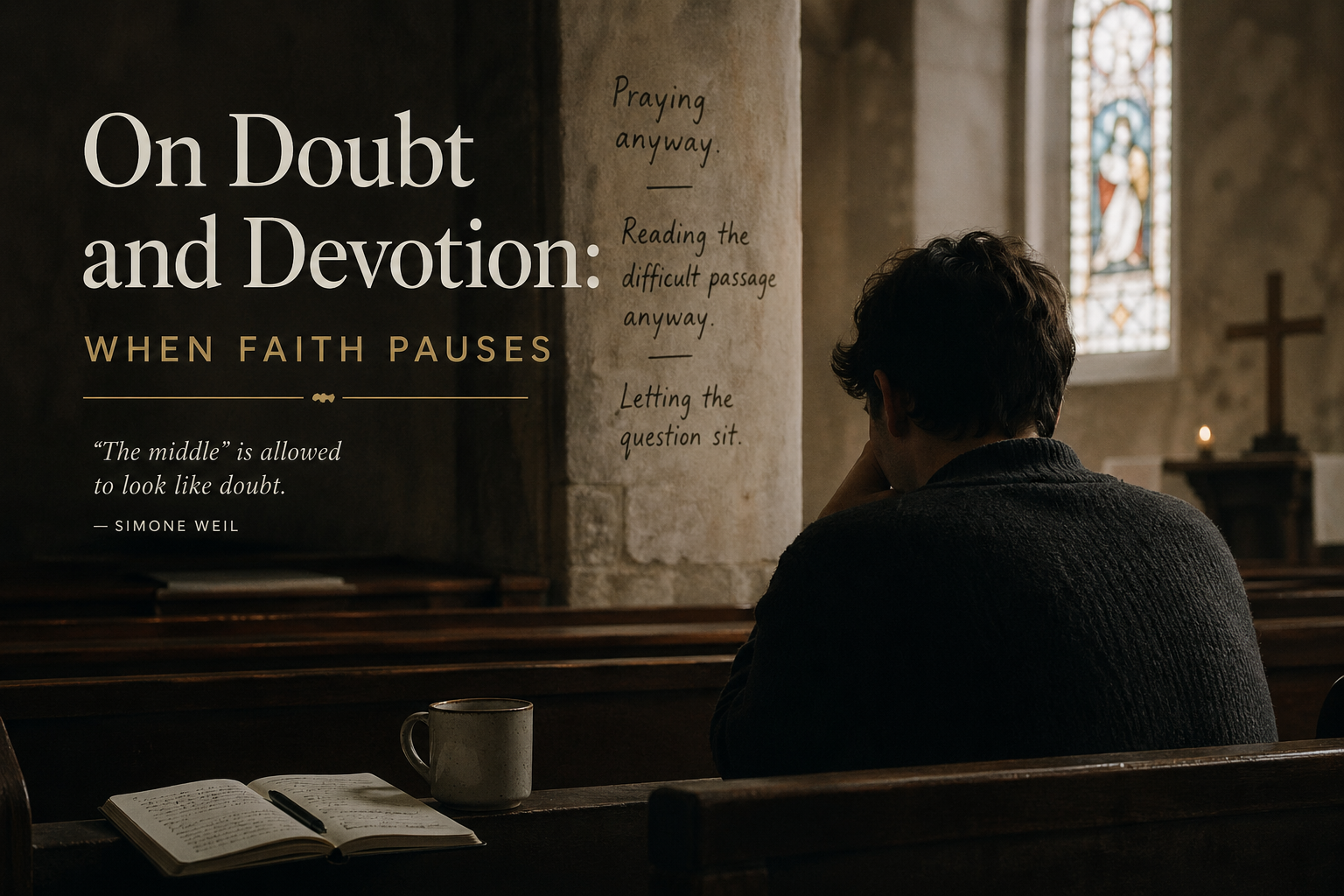
On Doubt and Devotion: When Faith Pauses
Article summary and tier readings
Faith is often mistaken for certainty, but it may be something far more demanding: the willingness to continue in the presence of doubt. Not-knowing isn't a failure of faith; it's what gives it meaning.
One prominent Christian framing treats doubt as a problem to overcome, a temporary obstacle on the way back to settled belief. That framing has done real damage. It teaches people to hide their doubts rather than hold them, and the hidden doubt almost always grows.
Kierkegaard, on the other hand, did not think doubt was the opposite of faith. He thought it was constitutive of it. Faith was not the absence of question; it was a posture sustained in spite of question. To remove the doubt was to remove the structural tension that made faith something other than mere conviction.
I am drawn to this not because it lets me feel better about my own pauses (though it does) but because it makes a specific claim about what faith is.
If faith is a movement made in spite of incomplete information, then doubt is not the antagonist of faith. It is the condition that makes the movement meaningful.
The pastoral consequence matters more than the theology. When a thoughtful person stops being able to recite the creed without flinching, the responses available to them are usually three: pretend the flinch isn't there, leave the tradition entirely, or descend into a private crisis the community cannot see. None of these are good.
The fourth option, which most traditions name but most parishes don't actually practice, is to continue showing up with the flinch. Praying anyway. Reading the difficult passage anyway.
Letting the question sit without resolving it artificially.
Simone Weil wrote that twenty centuries of Christianity will need a thousand years of attention to be understood. That is a long time. It implies we are all somewhere in the middle of the work, and "the middle" is allowed to look like doubt.
I have not stopped going to church because I sometimes don't know what I'm doing there.
I have come to think that not-knowing-quite-what-I'm-doing is part of going.
The Conversation
Reading is open to everyone. Commenting needs a sign in, by an emailed link or with Google.

This is an interesting article and very relevant to me. I am a deeply spiritual person, but I also recognize that there are three distinct Abrahamic religions, all stemming from the same time period and later corrupted or influenced over time by humans, power, war, money, greed, control, etc. Examples of this are woven through history when governments gain support for holy wars and crusades. Our societies tend to engage in "holy amnesia" to creatively blame other religions for this practice, while believing that their particular brand of religion is above reproach. In my opinion, each religion has core values that reflect the true virtues God would want us to embrace. The judgmental and violent overtones in each are human elements added over thousands of years. Until humanity learns to connect with God by embracing the core values of holiness, we will all keep working through this "middle ground," wondering why religion just doesn't quite feel right.
Commenter declared The Forum. Engine read The Spark.
Tier nominations
My position shifted after reading. What changed my thinking was:
Commenter declared The Spark. Engine read The Fog.